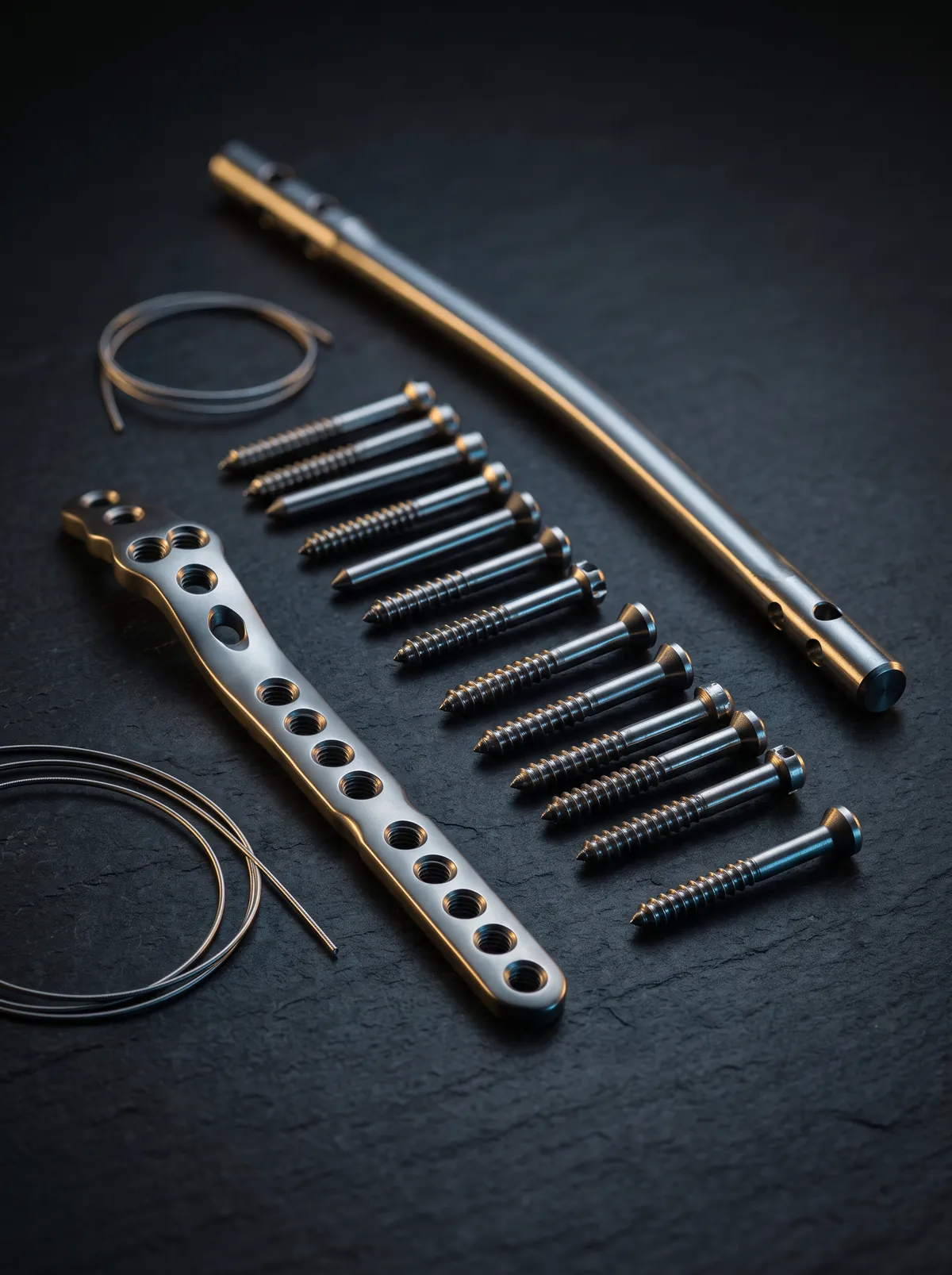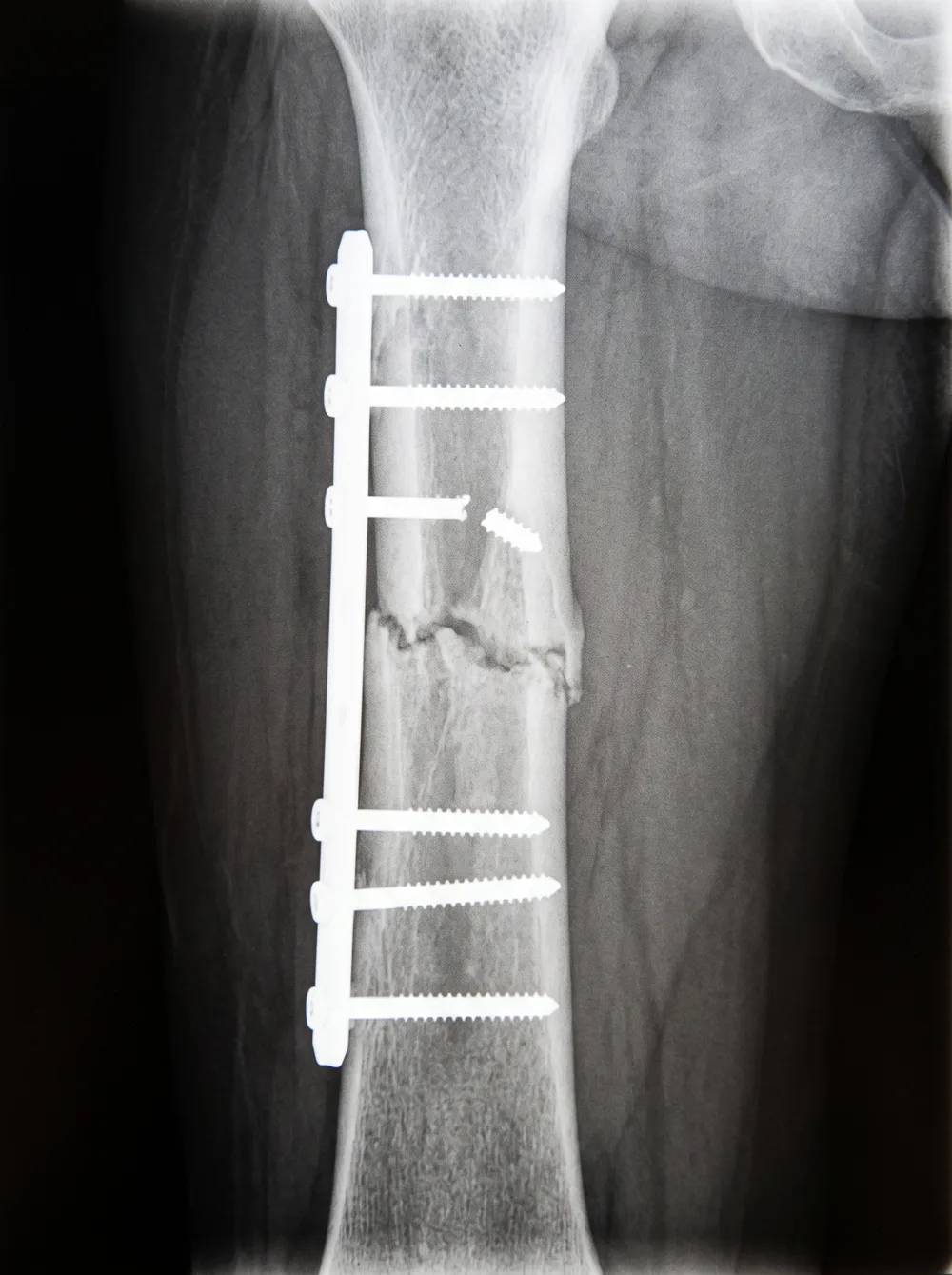
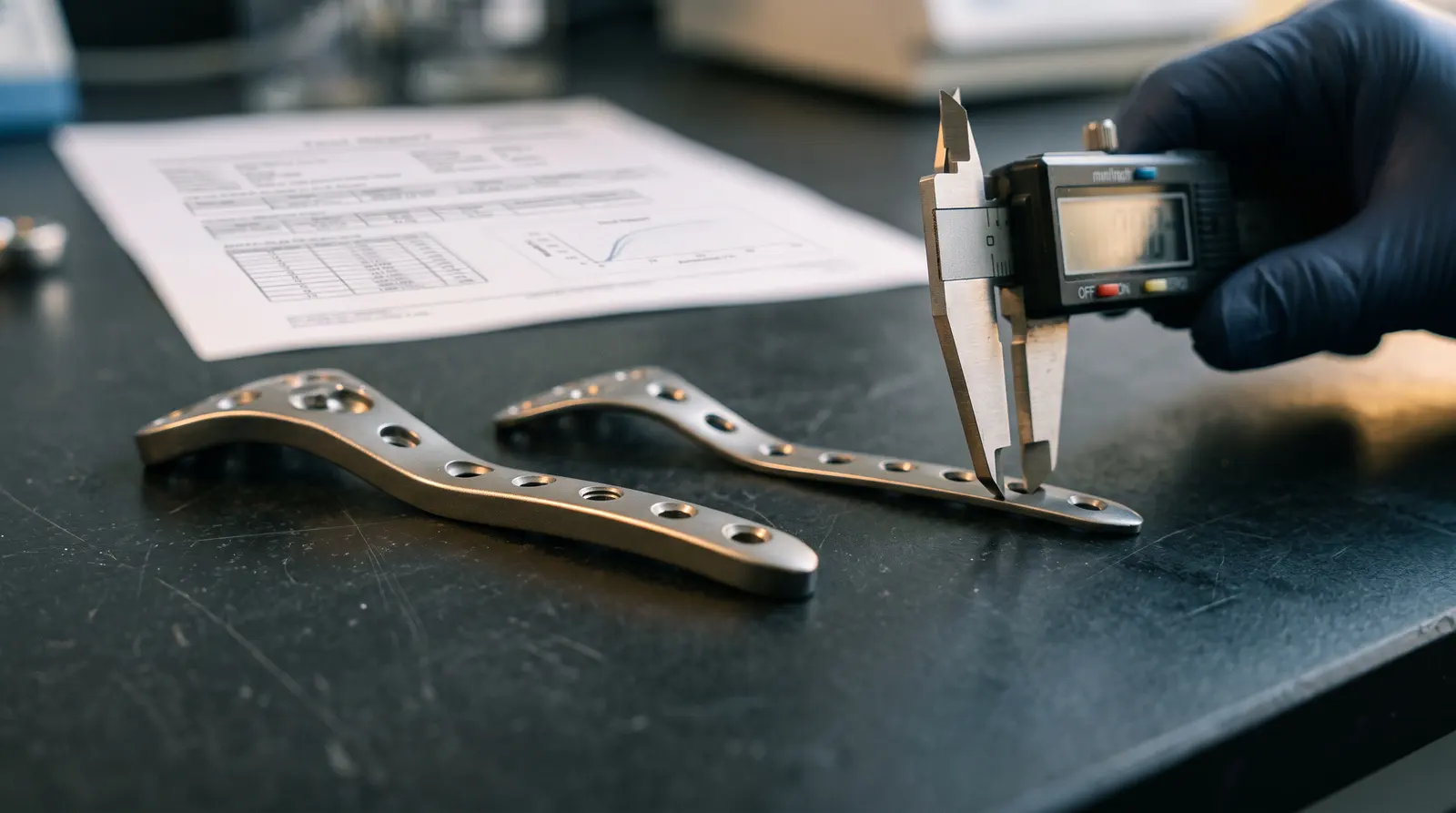
A compression plate holds a fracture by friction: its screws squeeze the plate hard against the bone, and the plate can also press the broken ends together. A locking plate holds it like a frame: its screws thread into the plate itself, so plate and screws become one rigid, fixed-angle structure that doesn’t need to touch the bone. Most modern plates have holes that can do either.
How a compression plate works
Conventional (non-locking) screws pass through the plate’s holes and grip the bone. As each screw is tightened, its head pushes the plate down onto the bone surface, and the friction between plate and bone is what stops the fragments moving. That means two things:
- The plate must be shaped to the bone (contoured), or tightening the screws will pull the bone towards the plate and shift the fracture.
- The bone must be strong enough to hold the screw threads; in soft, osteoporotic bone the screws can strip and the construct loosens.
The holes in a dynamic compression plate are oval with a sloped edge. Drilling at the far end of the hole and tightening the screw makes its head slide down the slope, which moves the bone a millimetre or so along the plate and presses the fracture ends together. For a simple transverse or short oblique fracture, that gives absolute stability: the bone heals directly, with little visible callus.
How a locking plate works
A locking screw has a threaded head that screws into a matching thread in the plate hole. Once locked, the screw can’t tilt or back out, so the plate, screws and bone form a single fixed-angle structure. Surgeons sometimes call this an internal fixator, because it behaves like an external frame placed under the skin.
- No need for perfect contouring. The plate doesn’t have to press on the bone, so it can sit just off the surface. That spares the periosteum, the thin layer on the outside of the bone that carries much of its blood supply.
- Better hold in weak bone. Each screw can’t loosen on its own; to fail, the whole construct has to pull out together.
- Bridging. Over a shattered (comminuted) area, the plate can span the zone without disturbing the fragments, giving relative stability: the bone heals with callus, like a fracture in a cast.
Many locking plates are anatomical: pre-shaped for one part of one bone, such as the end of the radius at the wrist or the top of the tibia, with screw directions chosen to catch the important fragments.
Combination holes, and the order screws go in
A locking compression plate has combination holes: half the hole is threaded for a locking screw, the other half is a sloped compression slot for a conventional screw. The surgeon decides, hole by hole, which kind to use.
When both kinds are used, the order matters. Conventional and lag screws go in first, to pull the fragments together and the plate onto the bone; locking screws go in after, to hold that position. A locking screw put in first fixes the plate’s distance from the bone, and a conventional screw tightened afterwards can then only strip or shift things. Theatre teams often say it as “lag before lock”.
When surgeons choose each
| Compression plating | Locking (bridge) plating | |
|---|---|---|
| Typical fracture | Simple transverse or oblique fracture in a shaft, and joint surfaces that must be rebuilt exactly | Shattered (comminuted) areas, fractures near joints, osteoporotic bone, around existing implants |
| Healing | Absolute stability, direct healing | Relative stability, healing with callus |
| Plate on bone | Must be contoured and pressed on | Can sit slightly off the bone |
| Main risk | Screws stripping in weak bone; poor contouring shifting the fracture | A construct that is too stiff, or screws locked off-angle |
The choice is the surgeon’s, and it depends on the fracture, the bone quality and the soft tissues. Locking plates cost more, so hospitals and value analysis committees often ask when the extra cost is justified.
Things that go wrong
- Cross-threading. A standard locking screw must enter on the hole’s axis; drilled off-angle, it can jam or fail to lock. Drill guides screwed into the hole prevent this, and variable-angle locking plates allow a range of angles by design.
- Too stiff. A bridge plate with many screws close to the fracture can stop the small movement callus needs, and the bone may heal slowly or not at all. Surgeons control this through the working length, the unsupported span over the fracture.
- Hard removal. Locking screws, especially titanium ones, can be difficult to remove years later.
- Fatigue. Any plate will eventually break if the bone doesn’t heal and the plate carries the load, cycle after cycle. Unit 2’s case is exactly that: a plate that bent in a patient nine weeks after surgery. Try Case 002 free →